What Is a Radiator and How Does It Work? The answer begins with heat transfer, not decoration. A Radiator is a heat-emitting device that warms nearby air, people, and surrounding surfaces. In a hot-water system, a boiler heats water and sends it through internal channels. The warm metal surface then releases heat into the room. Air beside the panel rises, while cooler air moves toward it. This creates a continuous circulation pattern. Simple, but not effortless.
Heating author Dan Holohan expresses the practical reality clearly: “Radiators don’t heat rooms; they heat people.” His point matters because comfort depends on more than room temperature. Wall insulation, window drafts, humidity, radiator placement, and furniture can change the experience. A large sofa pressed against a panel can block useful heat. That detail is often missed.
The International Energy Agency’s Buildings 2023 report states that buildings used about 30% of global final energy in 2022. Heating remains a major part of that demand in colder climates. The U.S. Department of Energy’s Energy Saver guidance explains that hydronic radiators distribute heat through heated water. CIBSE Guide B2 also highlights emitter sizing, control, and heat-loss calculations. These principles explain why two identical-looking rooms may need different radiator outputs. A cast-iron radiator stores heat longer. A steel panel usually responds faster. Electric models convert electricity directly into heat, but operating costs vary by tariff and efficiency. The textbook explanation is useful, yet incomplete. Real comfort depends on the whole system.
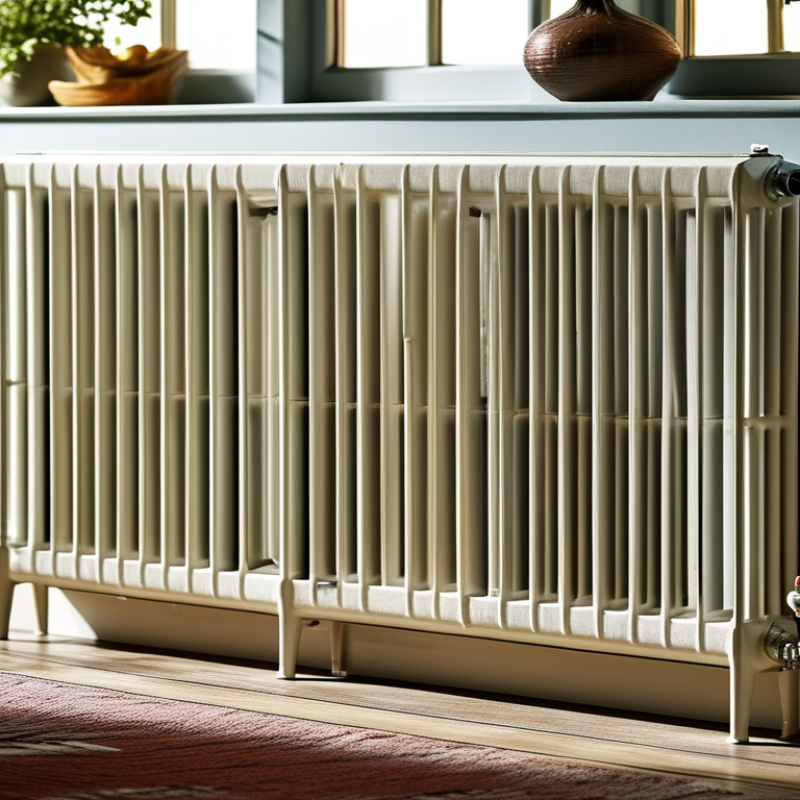
A radiator transfers heat from hot water into indoor air. Water usually enters between 70°C and 90°C in traditional heating systems. It moves through steel or aluminium panels, warming their surfaces. Heat then leaves through convection and infrared radiation. The water cools.
EN 442-2 uses 75/65/20°C as a common testing condition. That means 75°C flow water, 65°C return water, and a 20°C room. The average water temperature is 70°C. Its temperature difference from the room is therefore 50 kelvins. CIBSE Guide B2 also presents conventional system designs near 82/71°C. These figures explain why radiator sizing cannot rely on room area alone.
Radiator output changes with temperature difference. The standard uses an output relationship with an exponent commonly near 1.3. At 90/70°C, the average water temperature reaches 80°C. Against a 20°C room, the difference becomes 60 kelvins.
This can produce roughly 27% more heat than the 75/65/20 test condition, using that exponent.
ASHRAE Handbook—HVAC Systems and Equipment notes that flow rate, air movement, and control settings also influence real output. Tests are cleaner than lived rooms. Curtains, dust, and poor balancing reduce performance.
That shortcut can mislead. A radiator may feel hot but still heat unevenly.
Temperature readings should be checked at both valves.
A radiator transfers heat from hot water or steam into a room. Its core components work together. Tubes carry the heated fluid through the unit. Fins increase contact with surrounding air. More surface area usually means faster heat release, although airflow and water temperature also matter. Small parts matter.
Heat-emitting surfaces warm nearby air and people through convection and radiation. A metal panel may feel hot near the inlet, then cooler toward the outlet. That temperature change is normal. However, trapped air can block circulation and create cold sections. A practical inspection should check bleeding, pipe balance, and surface temperature. I have found that uneven warmth often points to control problems, not a defective radiator.
Valves regulate flow and room temperature. Thermostatic valves respond to local air temperature, while lockshield valves help balance different rooms. The U.S. Department of Energy identifies zoning and flow control as important features in hydronic heating efficiency. This matters because buildings consume about 30% of global final energy, according to the International Energy Agency’s Buildings report. Lower-temperature heating can reduce losses, but radiator output then falls. Engineers therefore compare tube size, fin design, operating temperature, and room heat demand. The common mistake is judging performance by touch alone. Surface feel is useful, but not precise. A calibrated thermometer gives better evidence.
A radiator is a metal heat exchanger that warms an indoor space through convection and radiation. In a hot-water system, heated water enters the radiator and transfers energy to its metal panels. The panels become warm, not instantly hot. That gradual change matters.
Convection carries much of the heat. Air touching the warm surface becomes lighter and rises toward the ceiling. Cooler air moves down to replace it, creating a continuous circulation loop. You can sometimes feel this movement beside a radiator, especially near the floor. The room warms unevenly at first. Furniture, walls, and air currents affect the pattern.
Radiation works differently. The heated metal sends infrared energy toward nearby surfaces, including floors, walls, and people. This is why your hands may feel warmer near the panel, even before the whole room reaches the target temperature. In practice, convection and radiation overlap. The distinction is not perfectly neat.
A thermostat controls the heating cycle by sensing room temperature. When the temperature falls, the system sends hot water or steam through the radiator. When the room reaches the set point, heating pauses. I have noticed that blocked radiators respond poorly. A curtain or sofa can trap rising air and reduce circulation. Dust can also limit performance, although its effect is often exaggerated. Bleeding may help some water radiators, but not every heating problem comes from trapped air.
A radiator transfers heat from hot water or electricity into a room. Its output is usually measured in watts, but the stated figure depends on testing conditions. A larger panel generally releases more heat, while fins increase the surface area without requiring a much wider unit. Double-panel radiators often provide higher output than single-panel models. However, room insulation, ceiling height, window size, and thermostat settings also affect comfort. A radiator’s label is not the whole story.
Material changes how a radiator responds. Steel models are common, durable, and reasonably priced. Aluminium heats quickly because it is lightweight and conducts heat well. Cast iron warms slowly but stores heat for longer, creating a steady, softer temperature. Thermal efficiency is often misunderstood. A radiator does not create energy efficiency alone; the boiler, heat pump, pipework, controls, and insulation matter too. That simple rule is useful, but not perfect. Real rooms behave differently.
Tips: Compare output at the same water temperature, not just by size. Check the manufacturer’s test standard and allow extra capacity for poorly insulated rooms. Keep furniture and thick curtains away from the panel. During a home inspection, I have seen a high-output radiator perform poorly because a sofa blocked its airflow. Measure the room carefully. Small mistakes become expensive.
What Is a Radiator and How Does It Work?
Performance Standards: Pressure Ratings, Heat Output, and Energy Control
A radiator transfers heat from hot water or steam into indoor air. In a water-based system, heated water enters through a valve, moves through internal channels, and leaves cooler. Metal surfaces warm nearby air and objects, creating a more comfortable room. The process looks simple, but performance depends on several measurable standards.
Pressure ratings protect the system from leaks and sudden failure. A radiator should withstand the system’s maximum working pressure, including pressure caused by heating and expansion. Installers should check the radiator rating, pipe condition, expansion vessel, and safety valve together. A pressure gauge reading alone cannot prove the system is safe. Small leaks around a valve may also reveal poor installation or corrosion. That detail is easy to miss.
Heat output is normally listed in watts, often measured under a stated water-to-room temperature difference. A larger radiator does not always provide more useful heat. Room size, insulation, window area, and water temperature change the result. Energy control improves through thermostatic valves, accurate room thermostats, and balanced flow rates. These controls reduce overheating by limiting water when the room reaches its target temperature. However, settings are not perfect. Furniture can block airflow, and a thermostat near a draft may misread the room. Regular inspection and careful adjustment remain necessary.
This comparison uses representative residential radiator specifications. Heat output is shown in watts per metre at a 50°C water-to-room temperature difference (ΔT50), while pressure ratings indicate typical maximum working pressure. Thermostatic radiator valves help control room temperature by regulating hot-water flow, reducing unnecessary energy use.
A radiator transfers heat from hot water into indoor air. Warm surfaces heat the room through convection and infrared radiation. The water cools afterward.
Traditional systems commonly use water entering between 70°C and 90°C. The exact temperature depends on system design and controls. Not always the same.
Heat output depends on water temperature, room temperature, airflow, and radiator surface area. A larger room usually needs more heat, but insulation also matters. Room area alone can mislead.
It means 75°C flow water, 65°C return water, and a 20°C room. The average water temperature is 70°C. The water enters hotter than it leaves.
A 90/70°C system has an average water temperature of 80°C. Against a 20°C room, the temperature difference is larger. Its theoretical output may be about 27% higher than the 75/65/20°C condition.
Trapped air can interrupt water circulation and create cold patches. Poor pipe balancing can cause similar symptoms. Bleed the radiator carefully, then check both valves.
Water normally enters warmer and leaves cooler. A gradual temperature drop across the panel is expected. A sudden cold area may indicate air, restricted flow, or poor balancing.
Thermostatic valves respond to nearby air temperature and adjust water flow. Lockshield valves help balance flow between rooms. Small adjustments can change comfort noticeably.
No. A hot surface does not confirm even heat distribution. Curtains, dust, and weak airflow can reduce performance. Use a calibrated thermometer when possible. Touch is only a rough clue.
A Radiator is a heating device that transfers heat from hot water, typically circulating at approximately 70–90°C, into the surrounding space. Its main components include internal tubes that carry the water, fins or other heat-spreading structures, control valves, and external surfaces designed to release warmth efficiently. As hot water flows through the radiator, heat moves through the metal and warms the room through both convection, which circulates heated air, and radiation, which transfers warmth directly to nearby objects and people.
Radiators are available in different designs and materials, each offering distinct levels of heat output, response speed, durability, and thermal efficiency. Their performance depends on factors such as surface area, water temperature, construction quality, pressure ratings, and the accuracy of energy-control valves. Choosing and operating the right radiator requires balancing heating capacity, system safety, comfort, and energy use.
