In 2026, choosing a condenser is less about naming a single “best” design and more about matching equipment to real operating conditions. Cooling load, water availability, outdoor temperature, floor space, and maintenance access all affect performance. An air-cooled condenser can simplify installation where water is scarce, though its fans may add noise and electrical demand. Water-cooled systems can transfer heat effectively, but they require a dependable water supply and suitable treatment. Evaporative condensers combine airflow and water, so humidity and local climate matter. Small details count. A shaded rooftop and a dusty service area can change what works well.
The categories also overlap with equipment design. Shell-and-tube and plate heat exchangers, for example, may be used in different condenser applications, depending on the process and fluid requirements. This guide compares common condenser types by operating principle, practical strengths, limitations, and typical use. It also considers efficiency, installation needs, service access, and the conditions that can affect long-term reliability. Manufacturer data and site-specific calculations matter more than broad claims or a simple ranking. A comparison without its assumptions can be misleading. The best choice depends on the application, and even a careful guide cannot replace an engineering review of the actual system.
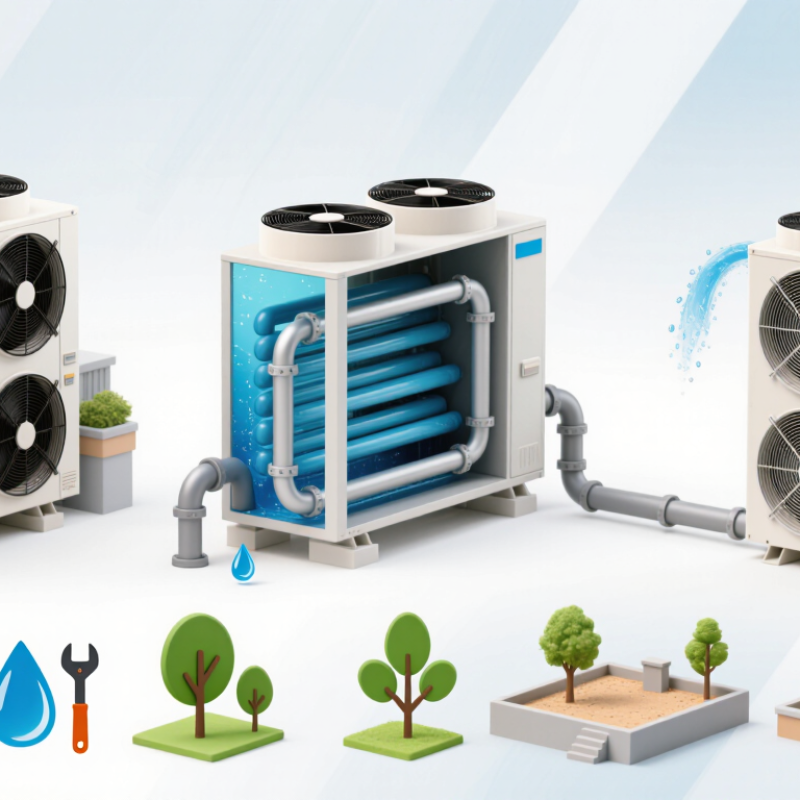
A condenser turns vapor into liquid by removing heat, not by “pressing” the vapor into a smaller space. Hot vapor enters a surface or chamber while cooler air or water carries heat away. As the vapor loses energy, its molecules slow and gather into liquid droplets. Those droplets drain from the equipment, while the cooling medium leaves warmer than it arrived. The phase change releases substantial heat. That change matters.
In a shell-and-tube condenser, vapor and cooling water pass through separate spaces divided by metal walls. A plate condenser uses thin, closely spaced plates, creating a compact path for heat transfer. Air-cooled designs move ambient air across finned tubes, avoiding a cooling-water circuit. Each type depends on the same basic process, but its size, flow pattern, and maintenance needs differ. A blocked passage or dirty surface can reduce heat transfer noticeably.
For 2026, choosing among these condenser types still begins with the actual operating conditions: vapor load, available water, air temperature, and acceptable pressure. A water-cooled unit may suit a steady, high heat load, while an air-cooled model can simplify installation where water is scarce. Small details count. A tidy diagram may suggest uniform flow, yet real systems can have uneven temperatures and fouling. Regular checks of outlet temperatures, pressure, and drainage help reveal those problems before performance slips.
Air-cooled condensers remain common in homes, small commercial buildings, and sites where water is scarce. Fans move outdoor air across a finned coil, releasing heat directly. Installation is usually straightforward, but hot weather can reduce performance. Dust on the fins matters. Water-cooled condensers, often shell-and-tube units connected to cooling towers, suit larger buildings and industrial systems. They can reject heat effectively, but need water treatment and regular tower maintenance. ASHRAE’s Handbook—Refrigeration describes these established arrangements; neither is best for every site.
Evaporative condensers combine airflow and water evaporation to cool refrigerant inside a coil. They are used in refrigeration and industrial applications where lower condensing temperatures are valuable. Remote air-cooled condensers are also common, placing the coil away from indoor equipment to manage heat and noise. Selection depends on climate, load, water availability, maintenance skill, and the system’s operating schedule. IEA’s The Future of Cooling report found that space cooling used nearly 20% of building electricity worldwide. That figure is a 2018 baseline, not a 2026 forecast, but it shows why condenser choice deserves careful review. A quieter or cheaper unit can still perform poorly when installed in a hot, cramped location.
What Are the Top Condenser Types in 2026?
How Air-Cooled, Water-Cooled, and Evaporative Condensers Differ
Air-cooled condensers release heat directly into outdoor air through finned coils and fans. They need no cooling tower or steady water supply. You can often spot them on a rooftop, where fan noise and clear airflow matter. Their output may drop on very hot afternoons, so check local peak temperatures before sizing a system. Simple does not mean maintenance-free: dust and blocked fins reduce heat transfer.
Water-cooled condensers move heat into circulating water, often paired with a cooling tower. They can suit large, steady loads, but require water treatment and regular checks for scale, corrosion, and leaks. Evaporative condensers use water evaporation to remove heat, often combining a coil, spray water, and airflow in one unit. They can use less energy than some air-cooled setups in suitable conditions, yet water quality and cleaning remain important. The better choice depends on climate, load, water access, space, and operating costs—not just the equipment’s rated efficiency.
Tips: Compare performance at your actual summer design conditions. Ask how often coils, basins, and strainers need cleaning. Small details matter. I’d also leave room for service access; crowded installations are harder to inspect and maintain.
| Comparison dimension | Air-cooled condenser | Water-cooled condenser | Evaporative condenser |
|---|---|---|---|
| How heat is rejected | Refrigerant transfers heat to outdoor air across a finned coil; fans move air over the coil. | Refrigerant transfers heat to circulating water, which typically carries it to a cooling tower or another heat-rejection system. | Refrigerant condenses inside a coil cooled by water spraying over the coil and air flowing across it; some spray water evaporates. |
| Main temperature influence | Outdoor dry-bulb temperature. Condensing temperature generally rises as outdoor air gets hotter. | Cooling-water temperature, which is influenced by outdoor wet-bulb temperature and cooling-tower performance. | Outdoor wet-bulb temperature, airflow, and water distribution. Evaporation can cool the coil below the outdoor dry-bulb temperature. |
| Water use | No routine heat-rejection water use. | Uses water in the cooling circuit and, when paired with an evaporative cooling tower, requires make-up water to replace evaporation, drift, and blowdown. | Consumes make-up water because a portion evaporates; additional water may be needed for blowdown. |
| Typical energy considerations | Fan power is required. High outdoor temperatures can increase condensing pressure and compressor energy use. | May support lower condensing temperatures than air cooling in suitable conditions, but pumps and cooling-tower fans also use energy. | Evaporative cooling can reduce condensing temperatures compared with dry air cooling in many climates; fans and water-distribution equipment use energy. |
| Maintenance focus | Keep coil surfaces clean and maintain fans, motors, and airflow clearances. | Manage water treatment, scaling, corrosion, biological growth, tube cleanliness, pumps, and cooling-tower components. | Maintain water quality and distribution; inspect coils, sumps, eliminators, fans, and spray components for scale, corrosion, or biological growth. |
| Space and installation needs | Requires outdoor space and adequate airflow around the coil; no cooling tower or condenser-water loop is needed. | Requires a condenser-water circuit and usually space for a cooling tower, pumps, piping, and water-treatment equipment. | Requires water supply, drainage or blowdown provisions, and outdoor airflow; often combines the condenser and evaporative heat-rejection equipment in one unit. |
| Common applications | Packaged air conditioners, air-cooled chillers, refrigeration systems, and installations where water use should be avoided. | Large commercial or industrial cooling systems where a water loop and the associated maintenance infrastructure are practical. | Industrial refrigeration and other applications seeking evaporative heat rejection where water and regular water-system maintenance are available. |
| Key trade-off | Simpler water-free operation, balanced against performance that is more directly affected by hot outdoor air. | Potential for effective heat rejection, balanced against water-system complexity, water treatment, and additional equipment. | Can benefit from evaporative cooling, balanced against water consumption and the need for careful hygiene and maintenance. |
Note: Actual performance, energy use, and water consumption depend on equipment design, climate, operating conditions, water quality, and maintenance.
What Are the Top Condenser Types in 2026?
Where Each Condenser Type Is Best Suited
Air-cooled condensers suit homes, small shops, and sites where water is limited. A fan moves outdoor air across finned coils, so installation is relatively straightforward. They need clear airflow and regular coil cleaning; dust and leaves can reduce heat transfer. In a hot, cramped equipment yard, performance may fall just when cooling demand rises. Space is tight.
Water-cooled condensers are often a better fit for large buildings and industrial systems with steady cooling loads. They transfer heat to water, commonly through a cooling tower, and can operate efficiently when properly maintained. The trade-off is added plumbing, water treatment, and checks for scale or corrosion. Water changes the equation. Shell-and-tube designs are common in these systems, especially where durability and service access matter.
Evaporative condensers can suit facilities seeking strong heat rejection in a smaller footprint, particularly in dry climates. They combine air movement with water evaporation, so they use less energy than some alternatives but still need water and routine cleaning. That sounds simple. It is not always. Humidity, water quality, noise limits, and maintenance staffing all affect the choice. A site assessment should compare local weather, operating hours, available utilities, and the cost of keeping each system clean—not just its rated efficiency.
Choosing a condenser in 2026 starts with the job it must do, not a catalog label. Estimate peak heat rejection, operating temperatures, and expected run hours. Air-cooled units can simplify installation where water is scarce, but output may drop on hot afternoons. Water-cooled shell-and-tube designs can suit steady, high loads when cooling water is dependable and properly treated. Evaporative condensers may use less energy in suitable climates, though scale, water quality, and seasonal maintenance need attention. A dusty rooftop, narrow service aisle, or noise-sensitive room can change the practical choice. It is rarely tidy.
Compare operating costs, not purchase price alone. Check fan and pump power, water use, cleaning access, corrosion risk, and changing loads. Ask engineers to state their assumptions about ambient temperature, fouling, and capacity; ratings are difficult to compare without them. Confirm the unit fits the site and can be serviced without moving nearby equipment. For variable demand, controls and turndown may matter more than peak efficiency. Coastal or dusty locations deserve closer review of materials and coil protection. Test the assumptions. A spreadsheet helps, but it may miss weak maintenance routines. Review actual site data before committing.
Common options include air-cooled, water-cooled, evaporative, and remote air-cooled condensers. Each suits different site conditions.
They suit homes, small shops, and places with limited water. Fans push outdoor air over finned coils. Keep leaves and dust clear.
Hot weather, blocked airflow, and dirty fins can reduce heat transfer. A cramped equipment yard can make matters worse. Space matters.
It often fits large buildings and industrial systems with steady cooling loads. Shell-and-tube designs are common, often paired with cooling towers.
It needs plumbing, water treatment, and regular checks for scale or corrosion. Tower maintenance takes time. That cost can be overlooked.
It combines airflow with water evaporation to cool refrigerant. It can suit facilities needing strong heat rejection in a compact area, especially in dry climates.
Not always. Water quality, humidity, cleaning needs, noise limits, and available staff affect their suitability.
Compare local weather, cooling load, operating hours, water access, maintenance skills, and available space. A rated efficiency figure alone can mislead. Remote placement may also help manage indoor heat and noise.
A condenser removes heat from vapor, allowing it to change into liquid. In 2026, common options include air-cooled, water-cooled, and evaporative condensers. Each uses a different method to release heat: air-cooled units rely on moving air, water-cooled systems transfer heat to circulating water, and evaporative designs combine water evaporation with airflow. These differences affect performance, water use, installation needs, and maintenance.
The best condenser depends on its setting and operating demands. Air-cooled models may suit locations where water is limited or a simpler setup is preferred. Water-cooled systems can be appropriate where a reliable water supply and heat-rejection infrastructure are available, while evaporative condensers may fit applications seeking a balance between cooling performance and resource use. Selection should consider climate, capacity, energy efficiency, water availability, space, maintenance, and long-term operating costs.
