What Are the Top Cable Types in 2026?

Time:2026-10-14 Author:Liam
0%

In 2026, choosing the right Cable is less about popularity and more about performance, distance, safety, and installation conditions. Homes may rely on fiber optic Cable for high-speed internet, while offices still use twisted-pair Ethernet for structured networks. Coaxial Cable remains useful for broadband, antennas, and video systems. USB-C, HDMI, and specialized power cables also support everyday devices, although their capabilities vary widely between versions.

Dr. Charles K. Kao, widely recognized as a pioneer of fiber-optic communication, said, “The prospects for optical fibre communications are very bright.” His observation still matters. Fiber can carry vast amounts of data through thin glass strands, with low signal loss across long distances. However, it is not automatically the best option. Fiber installation may require specialized tools, careful bend control, and trained technicians. Copper can be easier to terminate and maintain. That practical difference is often overlooked.

This guide examines the leading cable types expected to shape networks and connected devices in 2026. It considers bandwidth, durability, distance, flexibility, cost, and real installation demands. A cable’s label can mislead. “High speed” does not explain connector quality, shielding, cable length, or equipment compatibility. Small details matter. A poorly routed Ethernet cable near electrical machinery may create interference. An inexpensive USB-C cable may support charging but not high-resolution video. These weaknesses deserve attention, because no single Cable type wins every application. The most reliable choice comes from matching technical specifications with actual use, not from following market hype.
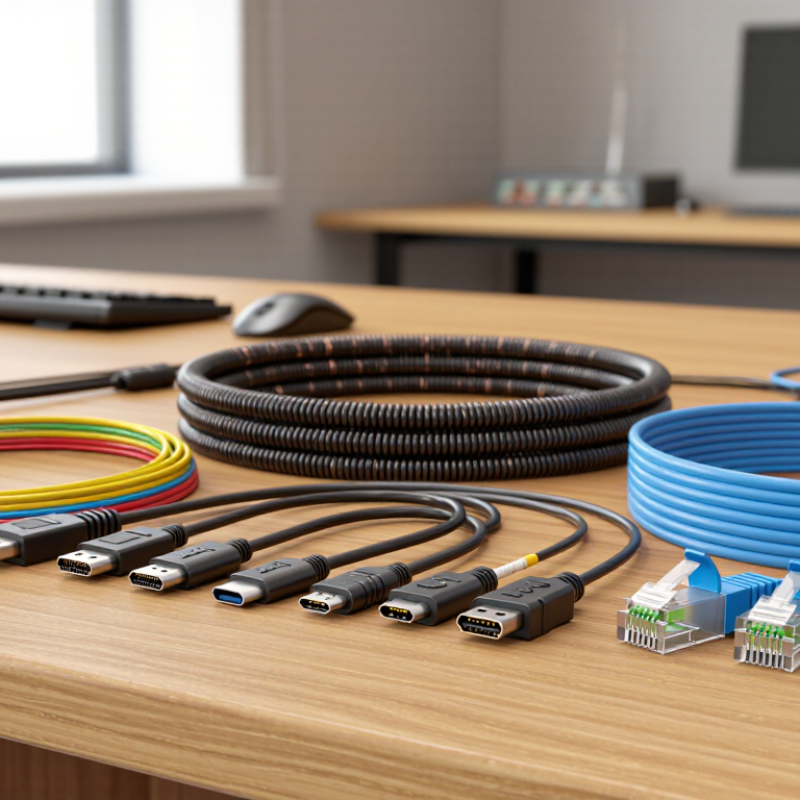
What Are the Top Cable Types in 2026?

Fiber-Optic Cables: 800G Ethernet Sets the 2026 Data-Center Benchmark

Fiber-optic cables are setting the 2026 data-center benchmark, with 800G Ethernet moving from laboratory demonstrations into demanding production networks. The Ethernet Alliance’s 2025 roadmap describes 800G designs using eight 100G lanes or four 200G lanes. This structure supports dense AI clusters while limiting switch-port growth. The IEEE 802.3 Ethernet standards work also provides the engineering framework for interoperable 800G transmission.

LightCounting’s 2025 optical-transceiver market analysis identifies 800G and faster modules as the fastest-growing segment through 2028. That demand reflects rising east-west traffic between accelerators, storage systems, and network switches.

In practice, single-mode fiber remains the safer choice for longer data-center rows and campus links. Multimode fiber can still suit shorter connections, especially where installation distance and optics costs matter. The wrong assumption is that speed alone solves congestion. Cable routing, connector cleanliness, thermal limits, and optical power budgets still decide reliability. No deployment is perfect.

Tips: Keep spare trunk capacity above today’s port count. Test every link at its planned speed, not only at 400G. Record insertion loss before equipment installation. A clean connector can prevent an expensive mystery. Also, review polarity and bend-radius rules during commissioning. These details feel minor, but field failures often begin there.

Coaxial Cables: DOCSIS 4.0 Targets 10 Gb/s Downstream (CableLabs)

What Are the Top Cable Types in 2026?

Coaxial cable remains important as DOCSIS 4.0 expands high-speed access. CableLabs specifications target downstream speeds of up to 10 Gb/s. They also define upstream capacity reaching 6 Gb/s. These figures depend on spectrum allocation, network design, and signal quality. They are technical targets, not guaranteed household speeds.

The CableLabs DOCSIS 4.0 specifications support extended spectrum and more efficient channel use. Full-duplex operation can improve upstream performance during heavy uploads. That matters for cloud backups, remote production, and interactive applications. The FCC’s 2024 broadband benchmark sets 100/20 Mb/s as the current basic fixed-service standard. DOCSIS 4.0 sits far above that threshold.

Real networks are messier. Splitters, aging connectors, and crowded neighborhood nodes can reduce performance. A clean installation matters. So does accurate modem provisioning. The 10 Gb/s figure can mislead readers when local infrastructure remains limited. I would also question whether most homes need that capacity today. Still, coaxial cable offers a practical upgrade path without replacing every buried line. Field technicians often find small faults first. That detail is easy to overlook.

What Are the Top Cable Types in 2026?

Maximum stated data rates for selected wired cable technologies and access standards.

Coaxial cable used with DOCSIS 4.0 targets downstream rates up to 10 Gb/s. Single-mode fiber can support 10 Gb/s symmetric access, while Cat 6A and Cat 8 twisted-pair cabling are rated for 10 Gb/s and 40 Gb/s respectively under specified distance limits. Actual service speeds depend on network design, distance, equipment, and shared-medium conditions.

Twisted-Pair Ethernet: Cat 8 Supports 40 Gb/s Over 30 m (TIA)

In 2026, Cat 8 twisted-pair Ethernet remains a specialized choice for short, demanding links. TIA specifications allow speeds up to 40 Gb/s over a 30-meter channel. That distance includes patch cords and connecting hardware. The cable commonly uses shielding to control interference at high frequencies. It also supports transmission frequencies reaching 2,000 MHz.

In a data center, this capacity can connect nearby servers, switches, and storage systems. The 30-meter limit matters, though. A rack may look compact, but cable paths quickly become longer than expected. Installers should measure the complete route, not just the space between equipment. They must also manage bend radius, termination quality, grounding, and separation from electrical wiring. Small installation mistakes can reduce performance.

Cat 8 is not automatically the best cable for every network. Its thicker construction can make crowded cable trays difficult to organize. It may also cost more and require compatible connectors and test equipment. I would not choose it for ordinary office runs without a clear bandwidth need. The specification is impressive, but real installations are less perfect. Heat, poor routing, and rushed testing still create weak points. A certification test after installation provides stronger evidence than a cable label alone.

USB-C Cables: USB PD Extended Power Range Reaches 240 W (USB-IF)

USB-C is becoming a leading cable type in 2026, especially as USB Power Delivery Extended Power Range reaches 240 W under the industry specification. That level uses higher voltage and current than standard charging modes. A compatible EPR cable can support demanding laptops, monitors, and compact workstation equipment through one connection. However, USB-C describes the connector shape, not guaranteed performance. Not every USB-C cable can safely deliver 240 W.

In practical cable selection, I check the printed power rating, supported data speed, and connector condition. EPR cables need suitable electronic identification and carefully designed conductors. Look for clear labeling rather than attractive packaging alone. A thin cable may feel convenient, but heat can build during sustained high-power charging. I have also found that cable length affects handling and installation space. Shorter cables often reduce clutter, although they are not automatically better. Specifications still matter more.

Tips: Match the cable rating with the charger and device. Inspect both ends for looseness, cracks, or unusual warmth. Avoid assuming a familiar connector guarantees full power. Keep high-power cables away from sharp bends. Test charging performance under normal workload, not only at idle. I still verify compatibility twice, because product labels can be incomplete or confusing. The 240 W figure is useful, but real performance depends on the complete charging system.

Power Cables: IEA Calls for Over $600B in Annual Grid Investment by 2030

What Are the Top Cable Types in 2026?

Power cables are becoming central to the global energy transition. The International Energy Agency estimates that annual grid investment must exceed $600 billion by 2030. This pressure is increasing demand for reliable transmission and distribution systems.

High-voltage alternating-current cables remain widely used for regional networks. High-voltage direct-current cables support long-distance transmission with lower energy losses. Underground power cables help reduce visual impact and improve urban resilience, although installation costs can be high. Subsea cables are also expanding as offshore generation connects to distant coastal grids.

Cable selection depends on voltage, distance, soil conditions, heat, and maintenance access. A cable that performs well underground may struggle under seawater pressure. That detail is easy to miss. It should not be.

Tips: Check the full route before choosing a cable. Review thermal ratings, conductor materials, insulation, joint quality, and emergency repair plans. Ask for test records and installation experience. Cheap procurement can create expensive failures later.

In practical grid projects, engineers increasingly combine cable types rather than rely on one solution. Overhead lines may serve open land, while underground sections pass through dense communities. Subsea links can connect islands or offshore facilities. However, supply bottlenecks and limited skilled labor may slow construction. Forecasts are useful, but they are not perfect. Local surveys still matter.

What Are the Top Cable Types in 2026? – Power Cables: IEA Calls for Over $600B in Annual Grid Investment by 2030

Major power-cable categories and their role in grid expansion
Cable type Typical voltage range Common conductor and insulation Primary applications Main advantages Key constraints 2026 grid relevance
Low-voltage power cables Up to 1 kV AC or 1.5 kV DC Copper or aluminium conductors; PVC, XLPE, or halogen-free insulation Buildings, factories, data centers, electric-vehicle charging, and local distribution Widely standardized, flexible installation options, and broad availability Limited transmission distance and current-carrying capacity compared with higher-voltage systems Demand is supported by electrification of transport, buildings, and industrial loads
Medium-voltage distribution cables Typically above 1 kV to 35 kV Copper or aluminium conductors; XLPE is widely used for underground systems Urban distribution networks, renewable-energy connections, industrial parks, and substations Suitable for undergrounding and efficient local distribution with lower visual impact Installation, fault location, and civil works can be costly in dense or congested areas A core cable category for distribution upgrades, resilience projects, and new load connections
High-voltage AC land cables Generally above 35 kV to 230 kV Large copper or aluminium conductors; cross-linked polyethylene insulation is common Transmission links, urban corridors, substations, and grid reinforcement Reduced right-of-way visibility and strong performance for high-capacity AC transmission High manufacturing and installation cost; thermal management and route planning are important Important where overhead lines face permitting, land-use, or community constraints
High-voltage AC submarine cables Commonly 66 kV for offshore collection and approximately 132–245 kV for export links Copper or aluminium conductors; XLPE insulation; metallic screens and protective armoring are used where required Offshore wind collection and export, island interconnection, and coastal transmission Enables power transfer across water and connection of offshore generation Seabed surveys, marine installation, repair logistics, and environmental permitting add complexity Strategic for offshore renewable build-out and cross-border electricity connections
HVDC land cables Typically ±320 kV to ±525 kV for modern long-distance projects Copper or aluminium conductors; XLPE insulation is increasingly used in new cable systems Long-distance transmission, asynchronous grid interconnection, and renewable-energy delivery Lower losses than equivalent AC transmission over long distances and controllable power flow Requires converter stations, specialized equipment, and coordinated system planning Supports integration of remote solar, wind, hydropower, and interregional electricity trade
HVDC submarine cables Commonly ±320 kV to ±525 kV; project voltage depends on distance and capacity Copper or aluminium conductors; XLPE insulation and subsea armoring are widely used Long-distance offshore wind export, interconnectors, and transmission between asynchronous grids Highly effective for long underwater routes and enables controllable cross-border transfers Very high project cost, limited repair capacity, converter-station requirements, and marine-route risks One of the most important cable technologies for offshore generation and international grid integration
Overhead transmission conductors From medium voltage through extra-high-voltage transmission levels Aluminium-based stranded conductors, often reinforced with steel or advanced composite cores Bulk power transmission, rural networks, and long-distance grid corridors Lower cost per route kilometre, efficient heat dissipation, and comparatively accessible maintenance Requires right-of-way, is exposed to weather and vegetation, and may face visual or permitting objections Remains essential because large-scale grid expansion cannot rely on underground cables alone
Context: The International Energy Agency has reported that annual global investment in electricity grids needs to rise from roughly USD 400 billion in the early 2020s to more than USD 600 billion by 2030 to support electrification, renewable-energy integration, reliability, and expanding electricity demand.
Reference: International Energy Agency, Electricity Grids and Secure Energy Transitions (2023). Voltage ranges are representative industry classifications; requirements vary by national standards and project design.

FAQS

Why are fiber-optic cables important for 2026 data centers?

They support very high-speed connections between computing systems, storage, and switches. 800G links are entering production networks. Dense clusters need them.

How is 800G Ethernet commonly structured?

An 800G connection can use eight 100G lanes or four 200G lanes. This design limits switch-port growth. It also supports dense computing clusters.

Should a data center use single-mode or multimode fiber?

Single-mode fiber suits longer rows and campus links. Multimode fiber can work well over shorter distances. Cost and installation length matter.

Does higher speed automatically remove network congestion?

No. Cable routing, connector cleanliness, thermal limits, and optical power budgets still affect reliability. Speed alone is not enough.

How can technicians prepare fiber links before installation?

Keep spare trunk capacity above today’s port count. Test every link at its planned speed. Record insertion loss before connecting equipment.

What small fiber details can cause field failures?

Dirty connectors, incorrect polarity, and tight bends can create unstable links. These faults look minor. They are not always minor.

What speeds does modern coaxial access technology target?

The stated targets reach up to 10 Gb/s downstream and 6 Gb/s upstream. Actual performance depends on spectrum, network design, and signal quality.

Can coaxial networks deliver their full advertised targets everywhere?

Not necessarily. Splitters, aging connectors, crowded nodes, and limited local infrastructure can reduce performance. The headline number may mislead.

Is coaxial cable still useful for network upgrades?

Yes. It can improve access without replacing every buried line. However, technicians must inspect small faults and confirm accurate modem provisioning.

Do most households need multi-gigabit service today?

Many may not need the full capacity yet. Heavy uploads, cloud backups, and interactive applications can still benefit. Needs vary, and that deserves review.

Conclusion

In 2026, cable technology will continue to advance across data centers, broadband networks, enterprise connectivity, consumer devices, and power infrastructure. Fiber-optic cables are expected to support 800G Ethernet, setting a new benchmark for high-capacity data-center links. Coaxial cables are also evolving, with next-generation broadband standards targeting downstream speeds of up to 10 Gb/s. For local networks, Cat 8 twisted-pair Ethernet cables can deliver 40 Gb/s over distances of up to 30 meters, making them suitable for demanding short-range connections.

USB-C cables are expanding their role in charging and data transfer, with extended power delivery reaching 240 W for compatible equipment. Meanwhile, power cables will remain essential to the global energy transition, as grid modernization requires more than $600 billion in annual investment by 2030. Together, these developments show how each Cable type is being optimized for greater speed, power capacity, reliability, and efficiency.

Liam

Liam

Liam is a dedicated marketing professional with a profound expertise in the industry, where he excels at highlighting the unique advantages of our core products. With a keen understanding of market trends and consumer needs, Liam frequently updates our company’s professional blog, providing......